Search This Blog

Showing posts with label Global Warming. Show all posts

Sunday, October 23, 2022

Climate change - the basics

Climate change - the basics

By Ranting Panda, 23 October 2022


In understanding climate change and global warming, it may help to distil the issue down to the most fundamental components:
  1. Hotter weather causes more severe storms. Warmer oceans tend to create stronger cyclones, hurricanes and typhoons. Heat fuels the intensity of bushfires. 
  2. Carbon dioxide (CO2) is a greenhouse gas (GHG) and affects global temperatures. 
Neither of these points is disputed in modern science. It would be surprising to find a climate change denier who would actually dispute either of these points. 

The main dispute they have is whether the world is warming and whether humans are the cause of it. 

The fact that the world is warming has been quantified in numerous studies, which I'll cover in more detail below.

CO2 emissions have risen dramatically since the mid-20th century and are around 50% higher than they were prior to the Industrial Revolution. Humans are contributing around 36 billion tons per annum of CO2 and other GHG. By comparison, volcanoes contribute around 200 million tons per annum. To make things worse, deforestation is reducing carbon sinks, so less CO2 is absorbed. Agricultural practices release more carbon from the soil, while our heavy reliance on beef has seen a dramatic increase in cattle populations, which produce significant levels of methane, also a GHG. All of these activities are caused by humans and are within our power to control.

Climate deniers have some regular talking points for rejecting the science behind anthropogenic climate change.


They will say that it is part of the common cycles of the Earth, or that back in the day there were hot days, strong cyclones, bush fires etc. They seem to think that scientists aren't aware of previous weather events. However, scientists benchmark and peer review. That's what they do. They actually account for previous weather events and climate changes. Scientists are not stupid, nor are they ignorant. No scientist wants to be known for getting something wrong, so they will test and review their hypotheses ad nauseum before publishing them.

However, there are many who still dispute the very obvious evidence of anthropogenic climate change, so the following points challenge some of the false claims made by climate change denialists.


The world is not warming

The first thing that scientists do is benchmark things. They analysis data to benchmark the current climate and then analyse data to determine how current climate compares to years gone by. These analyses show that the climate is clearly warming. Nineteen of the 20 hottest years on record have occurred since the year 2000 (NASA n.d.[c]).

It is just part of the natural climate cycles of the Earth

Climate change needs to be forced by some external factor. In this case, it is the concentration of carbon dioxide in the atmosphere. Funnily enough, scientists are an inquisitive lot, so they have measured the current CO2 concentration and compared it to concentrations of years gone by, going back millions of years. They know that prior to the industrial revolution, CO2 concentrations were 280 parts per million and that today they are 400ppm.

We know that CO2 is a greenhouse gas, which means it acts as an insulator to retain heat in the world, somewhat like a doona or a big old blanket. This is not in dispute by any scientist. We know therefore, that increases in CO2 concentration will force the planet to warm.

Milankovitch cycles

Milankovitch cycles are essentially the angle of the earth's rotational axis. Funnily enough, the axis doesn't go straight through the north pole to the south pole. It's a little off-centre. Milankovitch cycles are comprised of three key elements:
  • the shape of the Earth's orbit (eccentricity)
  • the angle that the Earth's axis is tilted at (obliquity)
  • direction Earth's axis of rotation is pointed (precession)
Eccentricity is on a 100,000 year cycle. Obliquity is on a 41,000 year cycle. Precession is on a 25,771 year cycle. On such long cycle times, insignificant changes to Milankovitch cycles over the last century cannot account for the dramatic increase in CO2, global warming or climate change (Buis 2020). 

Scientists are making it up

Yeah, but science! Climate is controlled by the laws of physics. Let me illustrate. Most people know that cyclones only form over warm water. Even the most ardent climate denier will agree with that. It is also known, that the warmer the water, the more intense the cyclone will be. Warm water helps create and intensify cyclones.

Ocean temperatures are increasing because of global warming, particularly because of the albedo effect. Albedo measures the ability of a body to absorb or reflect heat. Lighter bodies reflect heat, darker bodies absorb heat. The ocean is a dark body and has a low albedo. In other words, it absorbs almost all solar radiation and heat. Water expands as it heats, which is one of the causes of rising sea levels. As oceans warm, their ability to diffuse CO2 reduces, which means that more CO2 remains in the atmosphere. 

Ocean heat content (Kaufman n.d.)


Increased warming is also melting land ice, particularly the Greenland Ice Sheet and the West Antarctic Ice Sheet, both of which are already contributing to increased sea levels. Think this isn't a problem? The Antarctic ice sheet covers 14 million square kilometers and is on average around 2 kilometers thick, although is more than 4.7 km deep at its thickest. It has the ability to raise global sea levels by around 200 meters if it were to all melt.
 
Heat is also one of the key ingredients in the intensity of fire. The hotter the weather, the more intense the fires will be.

This is all basic and proven science. Scientists are not making this up.

It's all speculation and the 'other side' should also be taught

Ok, so what other side? That heat doesn't intensify storms, cyclones, hurricanes, or typhoons? That heat doesn't intensify fire, warm water or melt ice?

Scientists have quantified increases in CO2 concentrations. This is not in dispute.

Scientists have quantified that the world's climate is warming. This is not in dispute.

The only thing in dispute is whether anthropogenic carbon emissions are driving it. Scientists have run models showing what the climate would be like if there wasn't the increased anthropogenic carbon emissions. These models show that if there had been no change in anthropogenic carbon emissions since the industrial revolution, the world's climate would likely be in a cooling stage now.

Climate change deniers will often state that 3% of scientists dispute anthropogenic climate change. However, studies have found that the conclusions in those papers were faulty and unable to be replicated. Unlike the 97% of papers that found that global warming is real, is problematic and is largely caused by human activity. It should also be pointed out that of that 3%, not all of those scientists actually study climate in any form. This would be tantamount to asking everyone with a trade to comment on the effectiveness of electric vehicles compared to internal combustion vehicles. While some trades would be related, e.g. mechanics, auto-electricians, and even electricians installing EV charging stations, other trades wouldn't have a clue, e.g. butchers, bakers or carpenters. So when unrelated science fields are removed from the survey results and only climate scientists and associated scientists are included, more than 99% believe in anthropogenic climate change and 100% agree that humans are either primary or secondary causes of increasing CO2 emissions.

The sun is warming the planet

The Earth has seen a dramatic increase in warming and greenhouse gases. Yet, there has not been a corresponding change in solar irradiation or warming that would account for the dramatic changes experienced on Earth. The solar energy that Earth has been receiving has followed the natural 11-year cycles of the sun, with no significant changes over the last century that would explain Earth's global warming.

Perhaps the strongest indicator that the cause of Earth's warming is coming from the Earth itself, is that the surface atmosphere has warmed while the upper atmosphere (stratosphere) has been cooling. If the sun was causing global warming, then the stratosphere would also have warmed (NASA n.d.[b]). It is clear that the cause of warming is terrestrial and not solar. 

Solar irradiation cooling compared to global warming (NASA n.d.[b])


What about the Medieval Warm Period?

Again, science! Scientists do actually include such episodes in their research. Guess what? The world is warmer now than the Medieval Warm Period. So what caused the MWP? There was increased solar activity, decreased volcanic activity and changes in ocean circulation that brought much warmer water into the North Atlantic, which caused increased temperatures in Europe. The MWP was largely confined to western Europe and Britain, while other areas of the globe experienced much cooler temperatures. 

This differs to today's warming trend, which is global and not simply confined to western Europe or other geographical areas.  

The hockey stick graph was fabricated

The infamous hockey stick graph. Perhaps the most controversial graph in modern history. 

The graph was a combination of raw instrumental data and proxy data, measuring temperatures from the year 1400 to 1998. The raw instrumental data (e.g. thermometers) was used to record temperatures since 1950. The proxy data was used for data prior to the 20th century. Proxy data is often used in scientific analysis as a substitute for raw measures when scientific instruments are not available. Proxies are generally a good substitute as they provide indications of the phenomena being studied. For example, tree rings are wider during years of higher temperatures and humidity. Ice core samples capture C02, which can indicate higher temperatures. Proxies used by Mann et al in preparing the hockey stick graph included ice core samples, ice melt, ice accumulation, coral growth, tree rings and tree growth trends. They took into account natural climate forcing factors, such as volcanic activity and solar irradiance. 

Original hockey stick graph showing temperatures from 1400 (Mann et al, 1998, p 783)

Some have queried the use of proxy data, however an analogy of the use proxies may assist. Dr Chris Cogswell runs a podcast called The Mad Scientist. When discussing proxies used for determining historical climate data, he provided an analogy to simply explain their effectiveness (Cogswell 2017). 

The analogy looks at measures of household income. We may have data from some households in which we know specifically how much they earn. This is similar to the modern temperature records where we know exactly what the temperatures have been over the last few decades. However, say we also want to measure wealth in areas where we don't know the actual income. The specific data shows that wealthier households also tend to have larger houses in more upmarket neighbourhoods, they have more holidays and vacation in expensive locations, they own more vehicles which are generally more expensive. These measures are proxy indicators of wealth. Applying those will provide a good estimate of household wealth. However, like any scientific study, the data needs to be calibrated for accuracy. In doing so, it may be determined that the amount of holidays does not necessarily indicate wealth. After all, it may be that executives are under great pressure and expectations, so end up holidaying less, while workers at lower levels in the organisation may have more opportunity to holiday. Of course, location of holiday could still be an indicator of wealth. The hockey stick report by Mann et all (1998) discussed calibration of its data as well.

In 1999, Mann produced a new report measuring temperatures from the year 1000. The revised graph is shown below. 

Revised hockey stick graph showing temperatures from 1000CE (Mann et al, 1999)

Although the original hockey stick graph was questioned at the time, there have been a multitude of studies since, which have used numerous other methods for reconstructing historical climate patterns. These reports have confirmed that there is a significant increase in temperatures and atmospheric CO2 levels since the industrial revolution and in particular, since the mid-20th century (Skeptical Science, 2016). 

Further studies have considered data over much longer periods than Mann et al did. Current atmospheric CO2 concentrations are the highest they've been in around 1 million years.

Atmospheric CO2 levels are the highest they've been in around 1 million years (NASA n.d.[a])


Conclusion

Global warming is happening and it is forcing climate change. It is imperative that we reduce our carbon emissions to net zero as quickly as possible. The big concern is that we reach a tipping point, in which the world will continue warming under the weight of the increased atmospheric CO2 reservoir which will drive greater feedback, that is responses to warming, which in turn contribute to climate forcing factors that continue increasing GHG and forcing up temperatures. The tipping point is a point of no return, because at that point, our ability to reduce atmospheric CO2 concentrations will be outside our control and the world will continue warming uncontrollably. Sea levels will continue to rise, species will become extinct (as we are already starting to see), some plants will be unable to grow. All of this will affect our ability to continue an existence as we know it. 


Sources and references


Beernick, E, Lakey, A, Zarzuela, K, 2017, It was hotter in the Medieval Warming Period than today - brief responses to climate change denialism statements, 25 October, viewed 23 October 2022, CPSG 200 Science & Global Change Sophomore Colloquium, https://www.geol.umd.edu/sgc/elevator/elevator16.html

Benestad, RE, Hayhoe, K, Nuccitelli, D, Lewandosky, S, Hygen, HO, van Dorland, R, Cook, J, 2014, Learning from mistakes in climate research, Journal of Theoretical and Applied Climatology.

Buis, A, 2020, Milankovitch (Orbital) cycles and their role in Earth's climate, 27 February, viewed 23 October 2022, NASA, https://climate.nasa.gov/news/2948/milankovitch-orbital-cycles-and-their-role-in-earths-climate/

Cogswell, C 2017, Climate Change and Climate Denial, Episodes 20 and 21, 16 May, 31 May, The Mad Scientist Podcast, https://www.themadscientistpodcast.com/episode-20-climate-change

Deacon, B, 2022, Strong Antarctic polar vortex adds to south-east Australian rainfall and flood risk, BOM says, 23 October 2022, viewed 23 October 2022, https://www.abc.net.au/news/2022-10-23/antarctic-winds-drive-rain-south-east-australian-flood/101537816 

Earle, S, 2021, A Brief History of the Earth's Climate, New Society Publishers.

Kaufman, M, n.d., The carbon footprint sham, viewed 23 October, Mashable, 2022, https://mashable.com/feature/carbon-footprint-pr-campaign-sham

Mann, ME, Bradley, RS, & Hughes, MK, 1998, Global-scale temperature patterns and climate forcing over the past six centuries, 23 April, Nature, Vol 392, Macmillan Publishers Ltd 1998, http://www.meteo.psu.edu/holocene/public_html/shared/articles/mbh98.pdf

Mann, ME, Bradley, RS, & Hughes, MK, 1999, Northern hemisphere temperatures during the past millenium: Inferences, uncertainties, and limitations, 15 March, Geophysical Research Letters, Vol 26, pages 759-762. https://agupubs.onlinelibrary.wiley.com/doi/epdf/10.1029/1999GL900070

NASA, n.d. [a], Graphic: the relentless rise of carbon dioxide, viewed 23 October 2022, https://climate.nasa.gov/climate_resources/24/graphic-the-relentless-rise-of-carbon-dioxide/

NASA, n.d.[b], Is the sun causing global warming?, viewed 23 October 2022, NASA, https://climate.nasa.gov/faq/14/is-the-sun-causing-global-warming/

NASA, n.d.[c], Vital signs, viewed 23 October 2022, NASA, https://climate.nasa.gov/vital-signs/global-temperature/

NASA, n.d.[d], Evidence, viewed 23 October 2022, NASA, https://climate.nasa.gov/evidence/

National Science Foundation, n.d., Ice sheets, viewed 23 October 2022, https://www.nsf.gov/geo/opp/antarct/science/icesheet.jsp

Pearce, F, 2010, Controversy behind climate science's 'hockey stick' graph, 3 February, The Guardian, https://www.theguardian.com/environment/2010/feb/02/hockey-stick-graph-climate-change

Romm, J 2018, Climate Change: What everyone needs to know, 2nd edn, Oxford University Press, New York.

Saunders, T, 2022, A shift in wind direction across Sydney is behind the city's record wet year, 22 October, ABC News, https://www.abc.net.au/news/2022-10-22/sydney-record-wet-weather-2022-due-to-shift-in-wind-direction/101562826

Skeptical Science, 2015,  How does the Medieval Warm Period compare to current global temperatures?, 7 July, viewed 23 October 2020, https://skepticalscience.com/medieval-warm-period.htm

Skeptical Science, 2016, What evidence is there for the hockey stick, 12 October, viewed 23 October 2022, https://skepticalscience.com/broken-hockey-stick.htm


---0---


Sunday, September 22, 2019

Climate change - 4 factors of the apocalypse

Climate change - 4 factors of the apocalypse


There are several factors associated with climate change, but sceptics often confuse their disagreement with one to deny the veracity of others; essentially throwing the baby out with the bath water. These four key factors are interrelated, but also unique. Each is associated with climate change, but should be considered individually.

The four key factors are:
  • Climate change
    • believe it or not?
  • Causes of climate change
    • anthropogenic or natural?
  • Long-term impact
    • apocalypse or survivable?
    • mitigate or adapt?
  • Renewable energy versus fossil fuels
    • infinite & clean or limited & polluting?
Why do these need to be considered separately? Because, those who disagree with anthropogenic causes of climate change, its long-term impacts and renewable energy, argue as though climate change is not occurring. They will often deny anthropogenic causes and long-term impacts to argue against both climate change and the need to divest from fossil fuels.

Climate strikes

On 11 September 2019, Greta Thunberg, a Swedish climate change activist was interviewed by Trevor Noah on The Daily Show while she was in the United States for a climate change summit. Noah asked Thunberg, 'Do you feel a difference in the conversation, travelling from Sweden to America? Is there a different feeling around climate change?' Greta answered poignantly, 'I would say yes. Because here (America), it is discussed as something whether you believe in or not believe in, and where I come from it's more like "it's a fact" '.

Greta's activism started with a solo protest in 2018 and has inspired millions of people to turnout across the globe to protest against inaction on climate change. Some people criticised the students who attended these strikes, saying they should have stayed in school, but this is part of their education. Schools will often arrange excursions to parliament house so students can learn about democracy and government. The protests could be considered a school excursion where students gain practical experience in exercising democratic rights, freedom of speech and campaigning for the Earth. Funny that those who tell them to stay in school, deny the very science the students are learning about climate change.

It is a sad indictment that those who are trying to do the right thing by people and the planet are criticised by those who refuse to believe the science, who refuse to improve the planet or help others, and who are lost in their own greed, selfishness and ignorance. Sceptics shoot the messenger instead of listening to the message. They would rather criticise others than take real action to reduce human damage to the planet.

It's better to be a do-gooder, than to be a do-nothing.

Greta Thunberg's solo protest in 2018 led to millions campaigning across the globe in 2019
(McFall-Johnsen 2019)

Scottish comedian, Frankie Boyle, also known for his ascerbic and pithy commentary, tweeted an interesting observation about the climate strikes. His tweet stated, 'That kids have got to take time out of their childhoods to explain climate science to us should be a matter of profound shame'.

Trawling through social media and it is evident that conservatives have adopted a common theme. They will claim that Greta and the other school kids are being manipulated into rehashing leftist propaganda. There was a time when scientists were revered as experts in their field and any child who could understand the science was lauded for their intellectual prowess. Now conservatives are happy to dumb-down the education system so that children simply parrot the ignorant drivel of the right-wing as it pushes a neo-liberal agenda to continue the exploitation of the earth and its inhabitants.

My personal favourite squawking point of conservatives though, is the one that says 'kids should be kids' and not be raised to have this 'indoctrinated' fear of an apocalyptic future. I find this particularly ironic when it's parroted by the religious right ... remember Sunday School and the threats of eternal hell and damnation for those who failed to bow the knee to the God of love? It wasn't just the threat that the poor child might burn for eternity in Stygian darkness where there was wailing and gnashing of teeth, but that their godless family would too. Yeah ... let kids be kids ... it's ok to indoctrinate them with lies of Santa Claus and the Easter Bunny, to convince them of being eternally tortured by demons in the fires of hell, but God forbid that children study science and, like the prophets of old, warn the world of the dire consequences of inaction. As an afterthought, what would be the carbon emissions from hell? Any chance it could use some offsets and be carbon neutral? Burn in hell or burn in a warming world ... one of these choices is supported by science and the other by ancient ignorance fuelled by fear to control populations. It isn't Greta Thunberg who is being manipulated, it is the conservatives who refuse to accept the science.

Conservatives say 'kids should be kids & not fear the future', while promising torture by demons for eternity if they don’t worship the God of love.


Climate change

Climate change is occurring. This is indisputable. Whether you believe that the cause is part of Earth's natural cycles or caused by human factors is irrelevant. Quantifiable evidence proves that the world's climate is the warmest it has been in millennia. The planet's average temperature is around one degree warmer than it was 100 years ago, with much of the increase occurring in the last 35 years (NASA n.d.). To argue that we've always had hot summers or severe weather events, shows extreme ignorance of scientific research, because scientists do actually research and compare historical data.

The key word in 'climate change' is climate. Despite this, sceptics will often confuse climate and weather. If they experience a cold day or a cold winter, they'll laugh at any claim of a warming planet. Climate is the average weather pattern over a long period of time. Weather is the state of the atmosphere at any given point in time. Weather is a physical phenomenon. For example, hot air has lower pressure than cold air because the molecules are not as densely packed. This lower pressure can affect the flow of cold air as higher pressure areas flow into lower pressure areas. A warming climate causes change in weather conditions. For example, scientists have found that warmer conditions in the Arctic result in more severe winters across Europe and and North America (Gibbens 2019).

The planet is warming. Some people will say this is merely part of the normal cycles of the Earth, while others will state that humans are contributing to it through excessive emissions of greenhouse gases, such as carbon.

But right there we have agreement: the world is warming. Regardless of the cause, the climate is warming on a global scale.

The cause is increasing concentrations of greenhouse gases. But why the focus on CO2? After all, there are other greenhouse gases in the atmosphere. CO2 affects the global warming in a unique way. CO2 is responsible for around two-thirds of the world’s total energy imbalance because it absorbs less heat than other greenhouse gases (Lindsay 2019), which means it traps more heat, somewhat like a doona.

It may help to understand how much of the atmosphere is comprised of green-house gases before trying to understand the impact that human-induced carbon emissions has on global warming. The atmosphere is comprised of 78% oxygen and 21% nitrogen, totalling 99%. Neither of these are green-house gases. The remaining one percent includes various trace gases and the dominate green-house gases CO2, H20, CH4 (methane) and N20 (nitrous oxide). These gases are what keep the world warm. Before the industrial revolution, these gases comprised 300th of one percent of the atmosphere (OSS n.d). Because we are dealing with such miniscule concentrations to keep the Earth warm, relatively small changes can have a significant impact.

Atmospheric concentration of carbon dioxide is the highest it’s been in more than five million years. For 10,000 years, CO2 concentrations ranged from 280 to 290 parts per million (ppm), but over the last 150 years, CO2 concentrations have increased to 400ppm (Chang 2020). Where CO2 was 280th of one percent of the pre-industrial atmosphere, it is now 400th of one percent. This is a 43% change in the atmospheric CO2 concentration in 150 years!

It isn’t just the impact on the atmosphere that CO2 increases are a concern, it also the impact on the ocean. CO2 reacts with water molecules to produce carbonic acid, which lowers the ocean’s pH levels, thus increasing ocean acidification. The ocean’s pH level has dropped from 8.21 to 8.1 since pre-industrial times. This may not seem much, however, changes in pH levels have an exponential impact: a reduction of 0.1 in pH results in a 30% increase in acidification (Lindsay 2019). One impact of this is reduction in the ability for marine life to extract calcium from the water, which they need for building their shells or skeletons.

Methane is another green-house gas. Global warming is already causing Arctic permafrost to melt. There is a substantial quantity of methane stored beneath the East Siberian Arctic Shelf, which is already leaking into the atmosphere (Black 2010). As temperatures continue to rise, more of the methane will be released, increasing the greenhouse effect.

But are humans causing this increase in greenhouse gases?

Causes of climate change

This is really the main issue that sceptics have. If they separate this from climate change, they will usually admit that the planet is hotter than it has been for thousands of years; they will admit that they do not disagree with global warming, just the causes of it. So now we're making progress. Most people do believe in global warming. Yay!

Comprehensive studies have found that more than 97% of climate scientists believe in anthropogenic causes being the major factor in climate change (Nuccitelli 2019). Sceptics have tried to argue against this by citing articles that are usually not published by climate scientists or which haven't been peer-reviewed. One favourite is to refer to a petition that sceptics claim was signed by dozens of leading scientists opposing Canada's commitment to the Kyoto protocol, yet most of those who signed were not climate scientists and some were journalists (Le Page 2007a).

Carbon dioxide emissions are often referred to as pollution. Some sceptics argue that carbon dioxide is not pollution. Who cares what it is called, carbon dioxide is a green-house gas, and green-house gases warm the planet. That is without dispute.

So have people contributed to warming of the planet? Well, we live in a highly industrialised society of 7.5 billion people who are pumping out green-house gas emissions, including carbon dioxide among others, on a scale never before seen in recorded history. It should be kept in mind that scientists are not saying that the world's natural cycles are no longer in existence. They are saying that human factors have contributed to climate change and are exacerbating its effects. The following chart shows that atmospheric CO2 is the highest its been for more than 800,000 years, spiking from 1950 onwards. Can this really be blamed on natural climate cycles? As stated above, atmospheric CO2 concentration has increased by 43% since pre-industrial times.

Atmospheric CO2 (NASA n.d.)


Arguments against anthropogenic factors will often make comparisons to other events, for instance the Medieval Warming Period between 800CE and 1300CE. Scientists were criticised for their 'hockey stick graph' published in 2001, that showed a dramatic increase in global temperatures over the last 1000 years. The following is the original hockey stick graph (Le Page 2007b).


Sceptics claim that this model was fabricated, that scientists deliberately lied about the rise in temperatures. However, this isn't true. It is probably not a surprise, but there were no temperature records kept 1000 years ago. The original hockey stick model was based on modelling and assumptions regarding indicators of temperature, such as data from tree rings, coral, ice cores and historical records. While some of these assumptions have been corrected over time, scientists still conclude a significant increase in global temperatures over the last 1000 years. The following graph compares current research to the original hockey graph, showing that while it was over-stated, it wasn't that far off (Le Page 2007b). Ah, the benefits of peer-reviewed research ... as compared to those so-called scientists who publish articles that haven't been peer-reviewed..


Another argument is that volcanoes put out much more green-house gases than humans do. Funnily enough, scientists are an inquisitive lot and have researched this. Volcanoes (both on land and undersea) emit around 200 million tons of carbon per year (EarthTalk 2009). Whereas burning of fossil fuels emitted more than 36 billion tons in 2018 (Harvey 2018). Busting out the calculator we can see that volcanoes account for around half of one percent of the emissions of fossil fuels. The following chart is based on data from NASA and models emissions from volcanoes since 1880 against industrial carbon emissions ('What's really warming the world' 2015). So if people are willing to assign partial blame for climate change to volcanoes, why can't they accept emissions from fossil fuels must carry some blame too? After all, emissions from fossil fuels are 180 times that of emissions from volcanoes ... as of 2018. If we don't reduce these emissions, they will increasingly dwarf volcanic carbon emissions.


Compare this to green-house gas emissions, where there has been a 40% increase since 1750 (Bloomberg Business Week 2015).


Obviously, volcanoes are only one of the natural sources of COand other greenhouse gas emissions. When compared to all sources of greenhouse gases, industrial sources contribute about 5% of total global emissions. This may not sound like much, but there are a number of issues with this. Prior to about 1750, CO2 emissions were roughly in balance with the absorption of CO2 in heat sinks, which include the ocean, soil and forests. As human population has grown, there has been an increasing amount of deforestration and land conversion which has reduced the amount of heat sinks available to absorb CO2. The ocean absorbs some of these natural emissions that are no longer sequestered by land and forests, as well as some anthropogenic emissions. In doing so, there is increasing acidification of oceans, causing damage to ocean ecosystems, including reefs, fish and other ocean life. Around 40% of anthropogenic emissions are absorbed by heat sinks, while the rest remains in the atmosphere, contributing to global warming. The following image compares natural and anthropogenic production of CO2, (note, that this shows 2004 emissions, whereas 2018 emissions are 36 gigatons, a 27% increase in 14 years).

Carbon dioxide sources and sinks
(Brahic 2007)

The IPCC predicts that there are irreversible long-term effects of anthropogenic COemissions, including the very likely continuation of increasing ocean acidification throughout the remainder of the century as oceans continue absorbing atmospheric CO2, which is also rising because of land clearance and fossil fuel emissions (IPCC 2013, p. 469).

One argument against climate change is that it is a myth propagated by scientists seeking funding for research. Believe it or not, climate change is not the only show in town. Scientists get research funding for all manner of things, not just climate change. If there was no such thing as climate change, scientists would continue to be funded for other research.

Severity of impact

Just how serious will the impact of climate change be? Sceptics often carry on as though there will be no impact, however, some of that impact is being felt right now. Pacific Island nations are being affected by rising sea water, while the world is experiencing extreme weather events associated with the warmer climate.

The Intergovernmental Panel on Climate Change (IPCC) predicts the planet will be largely unlivable by 2100. A paper published by the Breakthrough National Centre (BNC), an Australian think-tank, predicts that if carbon emissions are not reduced by 2050, there is a 'high likelihood of human civilisation coming to an end' (Ahmed 2019). Retired Admiral Chris Barrie, who now works for the Climate Change Institute at the Australian National University in Canberra, believes that much of the knowledge provided to governments is too conservative, so existential risks are not identified or addressed (Ahmed 2019).

As mentioned earlier, climate change isn't the only show in town. Overpopulation and over-consumption are destroying forests and habitats, polluting air and water resources, and causing defaunation (the extinction of animal species and populations).

While not solely caused by climate change, defaunation is a major concern which has scientists suggesting that the world may be experiencing the sixth mass extinction event. Over the last century, we have witnessed the extinction of more than 200 species of animals and more than one billion animal populations, as a result of anthropogenic causes associated with key drivers of overpopulation and over-consumption, including over-exploitation of natural resources and habitats, pollution, toxification and climate disruption (Gerardo, Ehrlich & Dirzo 2017). These population decreases are a prelude to species extinction. Conservative estimates conclude that up to 50% of individual animals have been lost, with forecasts that this will worsen over the next couple of decades, threatening the future of both animal and human life (Gerardo, Ehrlich & Dirzo 2017). In Germany, more than 77% of insects have disappeared since 1989, while in North America, there's 2.9 billion fewer birds than in 1970, approximately a 29% reduction (Kilvert 2019). This impacts ecosystems, as birds and some insects pollinate crops, distribute seeds, may be predator or prey and perform many other ecosystem functions. The Intergovernmental Science-Policy Platform on Biodiversity and Ecosystem Services (IPBES) estimates that of the eight million species of animals, around one million are threatened with extinction within the next few decades (Sustainable Development Goals 2019). Climate change will impact ecosystems as animals struggle to survive. Those that adapt to warming will still be impacted because of the loss of other animals that their food chain is reliant on. If a predator adapts, but their prey doesn't, the predator will suffer as well.

The anthropogenic causes of defaunation, are also contributing to global warming. Deforestation for instance, results in the production of less oxygen, thus changing the atmospheric balance in favour of carbon dioxide, which is exacerbated by human overpopulation and industrialisation producing carbon dioxide and other greenhouse gases.

Ironically, two of the world's largest carbon emitting countries are also responsible for reducing the impact of global warming by planting almost one third of all new trees and plants on Earth over the last 20 years. While this greening helps the Earth, NASA believes that it does not offset the damage done to rainforest clearing in places such as the Amazon Basin, Democratic Republic of Congo and Indonesia. Some of this greening is because of agricultural industries which have converted native habitats into farms, which further drives defaunation and deforestation.

While some forecasts of the severity of climate change over the next few decades may seem alarmist, the concern is not just the impact of carbon emissions, but that it is coupled with other human-related environmental impacts. When sceptics state that 1000 years ago, the earth experienced this level of warming, they ignore the fact that people were not contributing to it through mass deforestation, defaunation, water scarcity, soil depletion, toxification, pollution of air and water, and excessively high and constant carbon-emitting industrialisation.

Climate change predictions are that more crops will fail, creating food shortages, while rising sea temperatures will reduce ocean productivity, impacting more than 20% of the world's population who rely on the ocean for food (McNutt 2013).

The mining and production of fossil fuels causes significant environmental damage through land clearance, pollution, and mineral run-off into rivers and seas. Investment in renewables and sustainable production will reduce carbon emissions, have less environmental damage and improve human health.

Global warming is contributing to rising sea levels in two ways: melting of land-based ice and thermal expansion of oceans because water expands as it warms (NOAA 2019). Approximately 10% of land on Earth is covered in ice, such as in glaciers and ice sheets which store around 69% of the world's fresh water (NSIDC n.d.). Land-based glaciers are mainly located in Greenland and Antarctica, but also found on most continents, including areas such as North America, Central Asia, North Asia, Africa and New Zealand. Rising sea-levels will create havoc for many of the world's major cities that are built close to coastal areas. This may result in the relocation of more than one billion people in the second half of this century (Spratt & Dunlop 2019, p. 13).

Some people are predicting apocalyptic scenarios caused by global warming. Others do not agree with the end of the world prognosis. Petteri Taalas, Secretary-General of the World Meteorological Organization has rebuked climate alarmists, stating that it is not going to be the end of the world. Taalas isn't saying that global warming is not a problem, but he is saying that 'we should stay calm and ponder what is really the solution to this problem' (Pentchoukov 2019). He acknowledges that there will be significant problems for some parts of the world, but that people can survive harsh conditions. Taalas isn't the only one who agrees with anthropogenic climate change, but who doesn't believe its impact will be as severe as some are claiming it will be.

Regardless of the causes or severity of climate change, what we do know is that the world is warming, is over-populated and people are over-consuming natural resources.

Renewable energy versus fossil fuels

Climate change activists are criticised for travelling in planes and cars emitting carbon, yet, how else are they going to travel. If anything, this is the very reason why climate change activists are campaigning for renewable energy. This criticism merely serves to make the case that activists are trying to make; that we need to invest in alternative and renewable sources of energy.

Economically, it makes far more sense to replace fossil fuels with renewables. For instance, the world is at the behest of major oil producing countries and organisations, such as OPEC. Recent drone strikes on two of the world's largest oil installations in Saudi Arabia are likely to result in higher oil prices globally (Hubbard, Karasz & Reed 2019). If nations were not importing their oil, but were able to produce their own energy, then there would be less risk of external actions threatening their energy supply and economies.

In Australia, the government has been attacking renewables and praising coal for years. This is extremely short-sighted because many nations are increasing their investment in renewables and divesting from coal and other fossil fuels. Yes, at the moment, there is a global reliance on coal, but many nations are increasing their investment in renewables. Conservative commentators like to claim that nations such as India and China are continuing to build coal-fired power stations. This is only half the story. These power stations are to meet immediate need, yet both nations are investing in renewables and divesting from coal as they plan for the future. India is one of the world's largest producers of renewable energy and over the last three years, has invested more in solar energy then in fossil fuels (Cockburn 2019). By 2024, India plans to reduce its coal imports by at least a third, and by 2030 it is estimated that coal's share of India's energy generation will reduce from 72% to 50% (Singh 2019).

In April 2019, the United States produced more renewable energy than coal-generated energy (Milman 2019). Production of renewable energy is becoming cheaper than coal as investment shifts to more sustainable and cleaner energy sources. On the back of investment, India produces the world's cheapest solar energy (Wood 2019).

Coal accounts for only five percent of the United Kingdom's energy mix and will be phased out entirely be 2025 (Thomas, Hook & Tighe 2019). This has occurred while the UK continues to have a strong economy.

Conclusion

Of the four factors above, we can conclude that climate change is occurring, most climate scientists believe in anthropogenic causes, the world is slowly increasing its use of renewables although over-consumption and over-population are contributing to climate change and driving other environmental risks, while there is some disagreement over the severity of climate change effects.

Actions to address climate change generally fall into two areas: adaptation and mitigation. Adaptation requires adjusting to changing conditions, perhaps through relocation of communities, types of crops grown and taking advantage of longer growing seasons. Mitigation involves reducing green-house gas emissions through replacing fossil fuels with renewable energy, and enhancing areas of sequestration, such as oceans, forests and soil.

Both sceptics and those who dismiss the apocalyptic forecasts prefer adaptation, because they believe it is more practical and less damaging economically. Meanwhile, mitigation is the main area of focus by activists.

Por que no los dos?

Adaptation is essential because mitigation is not going to dramatically reduce carbon emissions quickly enough to have a significant impact in the short-term. However, ong-term change will only be effected by adopting mitigation strategies now.

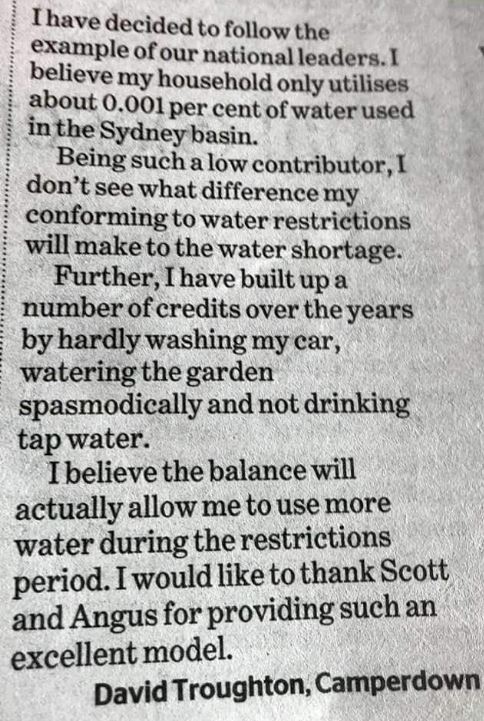
Many Australians, including some of its politicians, don't believe that Australia needs to take action because its contribution to global carbon emissions is tiny compared to much larger nations. Yet, at only 1.19% of the global total, Australia was the 16th largest producer of fossil fuel emissions in 2018. That leaves a further 205 countries with lower emissions than Australia. The consolidated emissions from Australia and these other 205 countries totals almost 25% of the world's fossil fuel emissions (Global Carbon Atlas 2019). Australia, as a developed western nation, must set an example for these nations in taking action to reduce carbon emissions. Every little bit helps. An astute, and somewhat cynical contributor to a local paper observed, his minuscule use of water compared to the larger total meant that he shouldn't have to comply with Sydney's water restrictions because it would make no difference based on Australia using the same reasoning to justify its reluctance to comply with carbon emission targets ... of course, if everyone thought like that ...


Let's assume that fossil fuel emissions are not contributing to the planet. Is it really such a bad thing to have cleaner energy. Apart from improved environmental outcomes, it would improve energy security. Imagine not being at risk of oil shortages because of war in the Middle East. Australia holds around three weeks worth of fuel in reserve, posing a significant risk to our economy, lifestyles and industry if there's war or other external security factors threatening it (McCutchan 2018).

With a population of almost eight billion people, the world cannot afford for us to continue consuming natural resources at the rate that we are. While there are some natural resources we still need to mine, for example, cadmium, zinc and other metals used in the goods we require, we can look at how we power those mines and the logistics used in transportation, storage and manufacturing. We can improve reverse logistics, to enhance recycling, reusing or repurposing of components and products. We can ensure mining is done sustainably to minimise environmental impacts, pollution, and run-offs into waterways. Meanwhile, mining of coal and extraction of other fossil fuels can be reduced and replaced in the long-term by production of cleaner, more sustainable, renewable energy. We could consider other resources for manufacturing products. Hemp, for instance, can be used in place of textiles, wood, plastic and so on. It is far more sustainable and presents massive environmental benefits.

What's the worst that could happen if governments and businesses reduce carbon emissions and embrace renewable energy? We end up with cleaner air, cleaner water, energy independence and security, healthier planet and people, improved liveability, food security, and sustainable industries that benefit people and the environment.


References

Ahmed, N 2019, 'New report suggests 'high likelihood of human civilization coming to an end' starting in 2050', Vice, 4 June, viewed 20 September 2019, https://www.vice.com/en_us/article/597kpd/new-report-suggests-high-likelihood-of-human-civilization-coming-to-an-end-in-2050.

Black, R 2010, ‘The history of air', Smithsonian Magazine, 18 April, viewed 27 January 2020, https://www.smithsonianmag.com/science-nature/the-history-of-air-21082166/.

Brahic, C 2007, 'Climate myths: Human CO2 emissions are too tiny to matter', New Scientist, 16 May, viewed 24 September 2019, https://www.newscientist.com/article/dn11638-climate-myths-human-co2-emissions-are-too-tiny-to-matter/.

Ceballos, G, Ehrlich, P & Dirzo, R 2017, 'Biological annihilation via the ongoing sixth mass extinction signaled by vertebrate population losses and declines', Proceedings of the National Academy of Sciences of the United States of America,  Vol. 114, No. 30, pp. E6089-E6096.

Chang, C 2020, ‘The science behind climate change and its impact on bushfires’, The Courier Mail, 25 January, viewed 26 January 2020, https://www.couriermail.com.au/technology/the-science-behind-climate-change-and-its-impact-on-bushfires/news-story/72de9c9ac880e98cb6c7fd14bfd6e509.

Cockburn, H 2019, 'India investing more money in solar power than in coal for first time', The Independent, 20 May, viewed 15 September 2019, https://www.independent.co.uk/environment/india-coal-solar-power-investment-money-climate-change-iea-a8921961.html.

Dunne, D 2019,  'One-third of world’s new vegetation in China and India, satellite data shows', Carbon Brief, 12 February, viewed 16 September 2019, https://www.carbonbrief.org/one-third-worlds-new-vegetation-in-china-and-india-satellite-data-shows.

EarthTalk 2009, 'Are volcanoes or humans harder on the atmospher', Scientific American, 11 February, viewed 20 September 2019, https://www.scientificamerican.com/article/earthtalks-volcanoes-or-humans/.

Gibbens, S 2019, 'Why cold weather doesn't mean climate change is fake', National Geographic, 23 January, viewed 15 September 2019, https://www.nationalgeographic.com/environment/2019/01/climate-change-colder-winters-global-warming-polar-vortex/.

Global Carbon Atlas 2019, CO2 emissions website, viewed 28 December 2019, http://www.globalcarbonatlas.org/en/CO2-emissions.

Harvey, C 2018, 'CO2 emissions reached an all-time high in 2018', Scientific American, 6 December, viewed 20 September 2019, https://www.scientificamerican.com/article/co2-emissions-reached-an-all-time-high-in-2018/.

Hubbard, B, Karasz, P, Hubbard B 2019, 'Two major Saudi oil installations hit by drone strikes, and US blames Iran', New York Times, 14 September, viewed 15 September 2019, https://www.nytimes.com/2019/09/14/world/middleeast/saudi-arabia-refineries-drone-attack.html.

IPCC 2013, Climate Change 2013: The Physical Science Basis. Contribution of Working Group I to the Fifth Assessment Report of the Intergovernmental Panel on Climate Change [Stocker, T.F., D. Qin, G.-K. Plattner, M. Tignor, S.K. Allen, J. Boschung, A. Nauels, Y. Xia, V. Bex and P.M. Midgley (eds.)]. Cambridge University Press, Cambridge, United Kingdom and New York, NY, USA, 1535 pp., https://www.ipcc.ch/report/ar5/wg1/.

Kilvert, N 2019, 'Bird populations are collapsing, and it's a sign of a bigger problem', ABC News, 20 September, viewed 20 September 2019, https://www.abc.net.au/news/science/2019-09-20/birds-collapse-us-bees-ecology-environment/11520008.

Le Page, M 2007a, 'Climate myths: Many leading scientists question climate change', New Scientist, 16 May, viewed 15 September 2019, https://www.newscientist.com/article/dn11654-climate-myths-many-leading-scientists-question-climate-change/.

Le Page, M 2007b, 'Climate myths: The 'hockey stick' graph has been proven wrong', New Scientist, 16 May, viewed 15 September 2019, https://www.newscientist.com/article/dn11646-climate-myths-the-hockey-stick-graph-has-been-proven-wrong/

Linsday, R 2019, Climate Change: Atmospheric Carbon Dioxide, National Oceanic and Atmospheric Administration, 19 September, viewed 26 January 2020, https://www.climate.gov/news-features/understanding-climate/climate-change-atmospheric-carbon-dioxide.

McCutchan, E 2018, 'Fact check: Does Australia have 3 weeks of petrol in reserve?', ABC News, 12 July, viewed 21 September 2019, https://www.abc.net.au/news/2018-05-23/fact-check-jim-molan-fuel-security/9687606.

McFall-Johnsen 2018, '2 striking photos taken just over a year apart show how Greta Thunberg's climate strike inspired millions', 21 September, viewed 21 September 2019, https://www.businessinsider.com.au/2-photos-show-how-greta-thunbergs-climate-strike-inspired-millions-2019-9.

McNutt, M 2013, 'Climate change impacts', Science, Vol. 341, No. 6145, pp. 435.

Milman, O 2019, 'US generates more electricity from renewables than coal for first time ever',  The Guardian, 27 Jun, viewed 14 September 2019, https://www.theguardian.com/environment/2019/jun/26/energy-renewable-electricity-coal-power.

NASA n.d., Climate change: How do we know?, National Aeronautics and Space Administration, viewed 21 September 2019, https://climate.nasa.gov/evidence/.

NOAA 2019, Is sea level rising, National Oceanic and Atmospheric Administration, viewed 20 September 2019, https://oceanservice.noaa.gov/facts/sealevel.html

NSIDC n.d., Facts about glaciers, National Snow and Ice Data Centre, viewed 21 September 2019, https://nsidc.org/cryosphere/glaciers/information.html.

Nuccitelli, D 2019, 'Millions of times later, 97 percent climate consensus still faces denial', The Bulletin,15 August, viewed 14 September 2019, https://thebulletin.org/2019/08/millions-of-times-later-97-percent-climate-consensus-still-faces-denial/.

OSS n.d., Atmospheric composition, OSS Foundation, viewed 27 January 2020, http://ossfoundation.us/projects/environment/global-warming/atmospheric-composition.

Pentchoukov, I 2019, 'Chief of World Meteorological Organization castigates climate alarmists', The Epoch Times, 8 September, viewed 14 September 2019, https://www.theepochtimes.com/chief-of-world-meteorological-organization-castigates-climate-alarmists_3073666.html.

Roston, E & Migliozzi, B 2015, 'What's really warming the world?' Bloomberg Businessweek, 24 June, viewed 15 September 2019, https://www.bloomberg.com/graphics/2015-whats-warming-the-world/?.

Singh, RK 2019, 'India, world's No. 2 coal buyer, plans to cut imports by a third', Bloomberg, 1 August, viewed 14 September 2019, https://www.bloomberg.com/news/articles/2019-08-01/india-world-s-no-2-coal-buyer-plans-to-cut-imports-by-a-third.

Spratt, D & Dunlop, I 2019, The Third Degree: Evidence and implications for Australia of existential climate-related security risk, Breakthrough - National Centre for Climate Restoration, https://www.breakthroughonline.org.au/papers.

Sustainable Development Goals 2019, UN Report: Nature’s Dangerous Decline ‘Unprecedented’; Species Extinction Rates ‘Accelerating, United Nations, 6 May, viewed 20 September 2019, https://www.un.org/sustainabledevelopment/blog/2019/05/nature-decline-unprecedented-report/.

Thomas, N, Hook, L, & Tighe, C 2019, 'How Britain ended its coal addiction', Financial Times, 1 October, viewed 27 December 2019, https://www.ft.com/content/a05d1dd4-dddd-11e9-9743-db5a370481bc.

Wood, J 2019, 'India is now producing the world's cheapest solar energy', World Economic Forum, 28 June, viewed 14 September 2019, https://www.weforum.org/agenda/2019/06/india-is-now-producing-the-world-s-cheapest-solar-power.


Updated 27 January 2020


Tuesday, November 28, 2017

Reds Under the Bed and the Axis of Leftists

Reds Under the Bed and the Axis of Leftists

It's no great secret that every political party has its 'talking points' for the week. They're easy to spot, because every time a member of that party is interviewed they'll use the same language and make the same points as each other.

One of the enduring talking points for Australia's Liberal and National Party coalition government is to accuse the Labor Party and the Greens of being Marxists, Leftists, socialists, communists ... and ... shock horror ... politically correct ...

Yes, ladies and gentlemen, when someone is being 'politically correct', run ... run like the wind ...

Political correctness is a savage beast that has come to slap a gag across our mouths, make boys dress as girls and have us all apologise to chickens for the hormones we inject in them. Scary.

Now, sadly there are some people who have accused the L/NP of living in the 1950s. What sort of rabid political correctness is this? Just because they believe that coal is the way of the future, and that copper wire is a good substitute for the more expensive fibre-optic cable, is no excuse to accuse of them of being 60 years behind the times.

So to prove that they aren't living in some pollution-riddled paradise with naught but rotary phones to communicate, they resurrect one of the greatest strategies of the mid-twentieth century: Reds Under the Bed.

Just when one thinks the L/NP couldn't get any more 50s, they completely knock it out of the park.

In almost every single interview, L/NP politicians are accusing the Labor Party, the Greens, and other dissenters, of being part of some great left-wing conspiracy. Not content to attack Unions, they have now turned their beady little bigotry on GetUp!, a politically independent activist organisation that dares to campaign for human rights, workers rights, marriage equality, and to challenge racism, bigotry and xenophobia at its roots. Apparently sticking up for the rights of people is part of a neo-Marxist agenda and political correctness gone mad. The government's attack on GetUp! is to claim it is a political 'associated entity', similar to the Unions, and therefore costing its political independence(1).

As an aside, if you wish to contribute to a legal expenses fund for GetUp! to defend itself against this unwarranted attack on its independence, please do so here: https://www.getup.org.au/campaigns/democracy/greatest-threat-to-getup/we-re-under-attack

This followed the biggest attack on the Union movement in 30 years(2), which was aimed at weakening workers' rights and destroying any form of collective power that could represent workers against unscrupulous employers. Instead, the government painted the Unions as being lawless, when employers have been abusing worker rights for years.

The Reds Under the Bed campaign of the 1950s, successfully demonised communism and convinced the gullible that communism was going to take over the world if mighty capitalism didn't conquer it.

The L/NP has resurrected the Reds Under the Bed scare-mongering, with illustrious MPs such as the Finance Minister, Mathias Corman, supported by a number of his colleagues, claiming that Labor leader Bill Shorten's economic agenda would lead Australia down the same path as East Germany and Cuba(3).

The government doesn't let up in its hyperbole, accusing Labor of the 'politics of envy'. Obviously singing from the same song-sheet, this was repeated by Corman(4), Treasurer Scott Morrison(5) and Prime Minister Turnbull, who ramped up the Reds Under the Bed campaign by maximising his bang for buck by accusing Shorten of being the 'most dangerous left-wing leader in generations' AND that 'he is a wholly-owned subsidiary of militant, left-wing unions who have no regard for the rights of others ...' (6). Apparently, wanting to share the wealth is envy, but wanting individuals to accumulate wealth by exploiting workers is not. Unions have no regard for the rights of others? Perhaps these conservative politicians could take a long hard look at themselves in the mirror ... or look at the innumerable businesses who are under-paying staff or denying employee entitlements, when they don't have Unions protecting workers.

Turnbull twisted the idea of equality by claiming that 'Labor's war on inequality is nothing more than a war on aspiration'. Meanwhile, the Liberal Party continues its war on wages. The coalition is using this Reds Under the Bed fear-mongering to dog-whistle the electorate into fearing unions, fearing Labor and worshiping the wealthy as their only means of attaining employment or economic security. Meanwhile, workers' rights continue to erode and wages stagnate(7).

In 2015, then Prime Minister Tony Abbott banned his front-benchers from appearing on Q&A because the show had allowed Zaky Mallah, to appear in the audience and ask a question. Mallah had been acquitted of terrorism charges in 2005, but had pleaded guilty to threatening to kidnap and kill Commonwealth officers. Mallah asked a question in relation to what would have happened had the Minister been deciding his case, rather than the courts. This was at a time when there was debate about having the Minister make the final call, rather than the courts. Abbott then described Q&A as a 'leftie lynch mob'(8). Regardless of the rights or wrongs of Mallah appearing, Abbott yet again had to dog-whistle the gullible with a derogatory comment about the left-wing.

In continuing the Reds Under the Bed dog-whistling, James McGrath, the Assistant Minister to the Prime Minister appeared on the ABC's Q&A on Monday 27 November 2017, where he launched a tirade against GetUp!, The Greens and Labor, claiming that the right-wing of politics was now facing an 'Axis of Leftists'. A claim he repeated a number of times, before culminating in an 'Armageddon of Leftists'(9). Was he trying to equate the left-wing with the Axis of Evil. Queue the scary music.


Everything that the Liberal or National Parties oppose is being branded as leftist, Marxist or politically-correct. National Party MP, George Christensen was one of many to brand the anti-bullying program, Safe Schools and Respectful Relationships, as being some sort of neo-Marxist gender theory. Christensen: 'We need to look at other methods that aren't originating in an ideology of queer gender theory, and let's be honest, Marxism'(10)

Former Labor leader, turned rabid right-wing apologist, Mark Latham wrote in his Daily Telegraph column, 'The craziest trend in Australian politics is to teach neo-Marxist genderless programs in our schools through the Orwellian-named Safe Schools and Building Respectful Relationships (BRR) curriculum'(11).  No, Mark, the crazy thing is labelling everything you disagree with as Marxist. Considering Marx espoused an economic theory that put the means of production in the hands of the workers, an anti-gay-bullying program does not qualify as Marxist ... neo or otherwise. There is nothing Orwellian in the naming of BRR as it was about ensuring schools would be safe from homophobic bullying ... such as we see from many of these politicians who attack it.

This is the standard that the Liberal and National Parties are bringing to the table; that the left-wing is full of evil Marxists who would turn Australia into Cuba or East Germany.

It is pure fear-mongering. It is aimed to manipulate the gullible with untruthful claims that turn workers against the very people who are fighting for their wages and rights, while driving them into the hands of those who would deny them those wages and rights.

More insidious and disturbing, is the dog-whistling of Marxism and leftist agendas to be used to justify homophobia, Islamophobia, xenophobia, racism, and straight out bigotry. We saw it during the Marriage Equality survey, where Yes campaigners were portrayed as neo-Marxists, we see it in the attacks on those who defend the rights of asylum seekers and refugees, the attacks on those who campaign for indigenous rights.

An article in the Cairns Post claimed that practically every element of our lives was being attacked by Marxists, including marriage, police, education, gender, religion, and crime. According to the article the only anti-Marxist crusaders in Australian parliament were Cory Bernardi, David Leyonhjelm, Pauline Hanson, the now defunct Malcolm Roberts(12). Each one of these is a disgrace to parliament and an insult to democracy as they attack many of the people who make up the Australian population. Leyonhjelm is currently attempting to have Milo Yiannopoulos address a gathering at Parliament House(13). Yiannopoulos is a well-known racist, xenophobe, misogynist and pedophile-apologist(14). Hanson is well-known for her hateful comments against indigenous people, Asians and Muslims(15). Bernardi is well-known for his hateful and false claims against Islam and Muslims, his raging against homosexuality and linking it to bestiality, and his demonising of asylum seekers(16).  And Roberts? Well, he had a spectacular fall from grace after being found ineligible to sit in parliament because of being a dual citizen. This was welcomed by many, as Roberts expressed his bizarre conspiracy theories on government and climate change.

Sadly, this is where the Liberal and National Parties are taking us. All their dog-whistling and fear-mongering about Marxism is driving people into the waiting arms of extreme right-wing parties such as One Nation. The 2017 Queensland election saw a 13% swing to One Nation, 20% in some areas, and most of that was from disenfranchised Liberal National Party voters. Ironically, One Nation struggled to win a single seat, and the swing to them took the LNP down as well.

While the LNP and One Nation try to blame Labor for this, part of it has to rest with the constant fear-mongering about Marxism which is resulting in people truly believing that extremists such as Hanson and Bernardi are the only way to innoculate society against it.

Masking the attacks on Labor and the Greens as an attack on neo-Marxism is disingenuous and dangerous. The real attack is on the people; on indigenous rights, workers' rights, refugees, Muslims. The scare-mongering is dividing the people against themselves. Workers are hating Unions, non-Muslims are hating Muslims, straight people are hating LGBTIQ people, non-indigenous Australians are demonising indigenous people ... and on it goes. Meanwhile, while the electorate's energy and passion is directed at hating others, the government continues to undermine the rights of us all, including attacking our freedom of speech and expression as we see with the incessant attacks on the ABC, SBS and now GetUp!

The right-wing may be scaring itself stupid with fear of the left and launching into paroxysms of rage with every claim of Marxism (neo or otherwise), yet the biggest threat is the slide towards the ultra-right-wing, where diversity is not tolerated or celebrated.

Margaret Atwood, author of The Handmaid's Tale, a dystopian novel of a theocratic USA, succinctly describes the demonisation of 'others', when she said, 'Heroes need monsters to establish their credentials. You need something scary to overcome'. The L/NP has been demonising others for years. It is the only way they can portray themselves as the heroes, the saviours of modern Australia.

It is this turning of Australians against each other by attacking human rights, that will usher in an end to the freedoms that Australia enjoys, and it is this that Australians should all be standing up against - as one!


References

1. The Sydney Morning Herald, Adam Gartrell, GetUp! readies for court battle over bid to link it to Labor and the Greens, 23 October 2017, http://www.smh.com.au/federal-politics/political-news/activist-group-getup-readies-for-court-battle-against-coalition-investigation-20171021-gz5nyg.html. Accessed 28 November 2017.

2. The Guardian, Patrick Wintour, Biggest crackdown on trade unions for 30 years launched by Conservatives, 15 July 2016, https://www.theguardian.com/politics/2015/jul/15/trade-unions-conservative-offensive-decades-strikes-labour. Accessed 28 November 2017.

3. The Australian, Greg Brown, Bill Shorten 'will turn us into Cuba', 27 August 2017, http://www.theaustralian.com.au/national-affairs/bill-shorten-will-turn-us-into-cuba/news-story/a8545f0f3045b68c6e63ab434803d0d2. Accessed 28 November 2017.

4. News.com.au, staff writer, Finance Minister Mathias Cormann slams Bill Shorten's 'communist' economic policy, 24 August 2017, http://www.news.com.au/national/politics/finance-minister-mathias-cormann-slams-bill-shortens-communist-economic-policy/news-story/d1134a0aa6f3b19ebc4f72f8cca2fcaf. Accessed 28 November 2017.

5. SBS,  Source: AAP, Shorten chasing politics of envy: Treasurer, 24 July 2017, http://www.sbs.com.au/news/article/2017/07/24/shorten-chasing-politics-envytreasurer. Accessed 28 November 2017.

6. The Sydney Morning Herald, Amy Remeikis, Bill Shorten the 'most dangerous left wing leader in generations', says Malcolm Turnbull, 12 August 2017, http://www.smh.com.au/federal-politics/political-news/bill-shorten-the-most-dangerous-left-wing-leader-in-generations-says-malcolm-turnbull-20170812-gxuug0.html. Accessed 28 November 2017.

7. The Sydney Morning Herald, Anna Patty, War on wages: Australians are working harder and going backwards, 5 August 2017, http://www.smh.com.au/business/workplace-relations/war-on-wages-australians-are-working-harder-and-going-backwards-20170803-gxoh9c.html. Accessed 28 November 2017.

8. The Sydney Morning Herald, Matthew Knott, Q&A fallout: Tony Abbott orders frontbench ministers to boycott ABC show, 6 July 2015, http://www.smh.com.au/federal-politics/political-news/qa-fallout-tony-abbott-orders-frontbench-ministers-to-boycott-abc-show-20150705-gi5olb.html. Accessed 28 November 2017.

9. ABC, Q&A, Royal Commission and Election Results, 27 November 2017, http://www.abc.net.au/tv/qanda/txt/s4752801.htm, Accessed 27 November 2017.

10. ABC, Michael Bradley, The problem with evoking Marxism in the Safe Schools debate, 24 March 2016, http://www.abc.net.au/news/2016-03-24/bradley-marxism-and-safe-schools/7272764. Accessed 28 November 2017.

11. The Daily Telegraph, Mark Latham, From reason to radicalism: Gender fluidity, 31 May 2016, https://www.dailytelegraph.com.au/news/opinion/from-reason-to-radicalism-gender-fluidity/news-story/832eb330f1e68c0af8ab37521dc402d7. Accessed 28 November 2017.

12. The Cairns Post, Julian Tomlinson, Marxism aims to destroy conventional society ... and it's happening every day, 29 June 2017, http://www.cairnspost.com.au/news/opinion/marxism-aims-to-destroy-conventional-society-and-its-happening-every-day/news-story/368944a48185fd9f208aca6cb8557a48. Accessed 28 November 2017.

13. SBS, Source AAP-SBS, Greens want to ban alt-right figure Milo Yiannopoulos, 28 November 2017, http://www.sbs.com.au/news/article/2017/11/28/greens-want-ban-alt-right-figure-milo-yiannopoulos. Accessed 28 November 2017.

14. Anti-Defamation League, Milo Yiannopoulos: Five Things to Know, https://www.adl.org/education/resources/backgrounders/milo-yiannopoulos-five-things-to-know. Accessed 28 November 2017.

15. Huffpost, Josh Butler, Pauline Hanson Says She's Never Said Anything Racist Ever, 29 March 2017, http://www.huffingtonpost.com.au/2017/03/29/pauline-hanson-says-shes-never-said-anything-racist-ever_a_22016461/. Accessed 28 November 2017.

16. ABC, Ashlynne McGhee, Cory Bernardi: Where does the Senator stand on key issues?, 6 February 2017, http://www.abc.net.au/news/2017-02-06/cory-bernardi-profile-who-is-he-and-where-does-he-stand/8244040. Accessed 28 November 2017.